

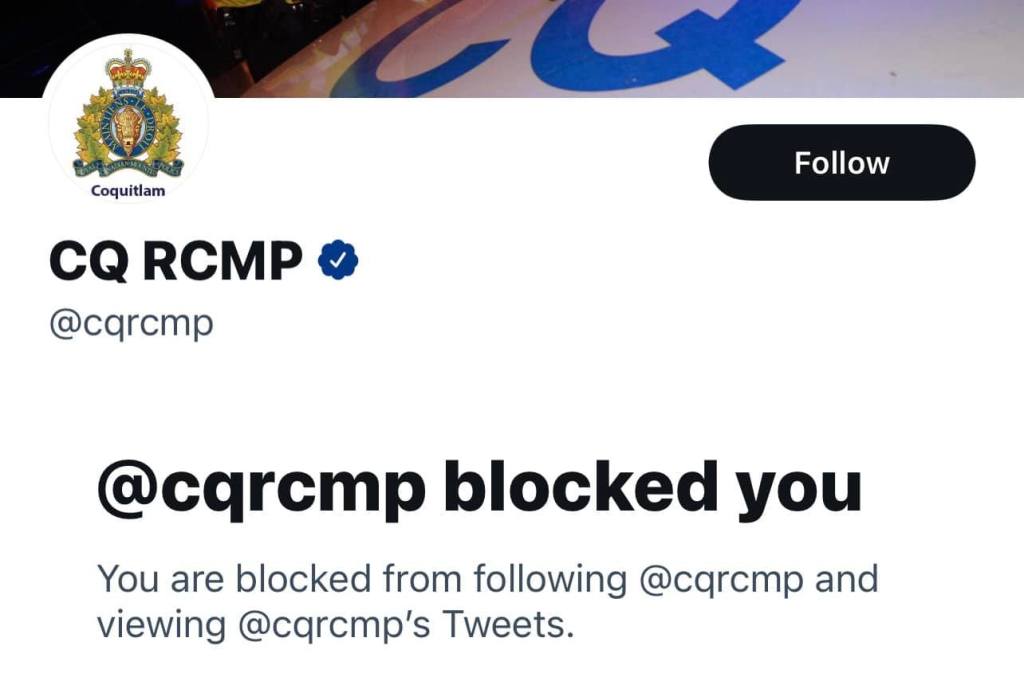
April 13th, 2022, the Coquitlam RCMP blocked Nicola Spurling, on Twitter, after she shared the results of an Access to Information (ATI) request. In response to media inquiries about this action, which may constitute a Section 2 Charter violation, the Coquitlam RCMP lied about the reason for blocking Nicola on Twitter. They claimed she was revealing private information – information on a public employee, which they supplied to her, as part of the ATI request.
Attempting to find recourse has proven to be almost impossible. Subsequent ATI requests are being delayed, long past the statutory deadline. When responses to ATI requests are received, they appear to purposefully misgender Nicola. The Office of the Information Commissioner, which can be contacted to make complaints about ATI requests, is unresponsive. Filing a Canadian Human Rights Act complaint takes years, and can be costly if representation is needed. Filing a lawsuit is also time consuming and costly, but seemingly the most effective option, though it burdens taxpayers, if successful.
The Coquitlam RCMP are accountable to the federal government, but who are they accountable to in Coquitlam, the city that hires them? This graphic may provide some insight:
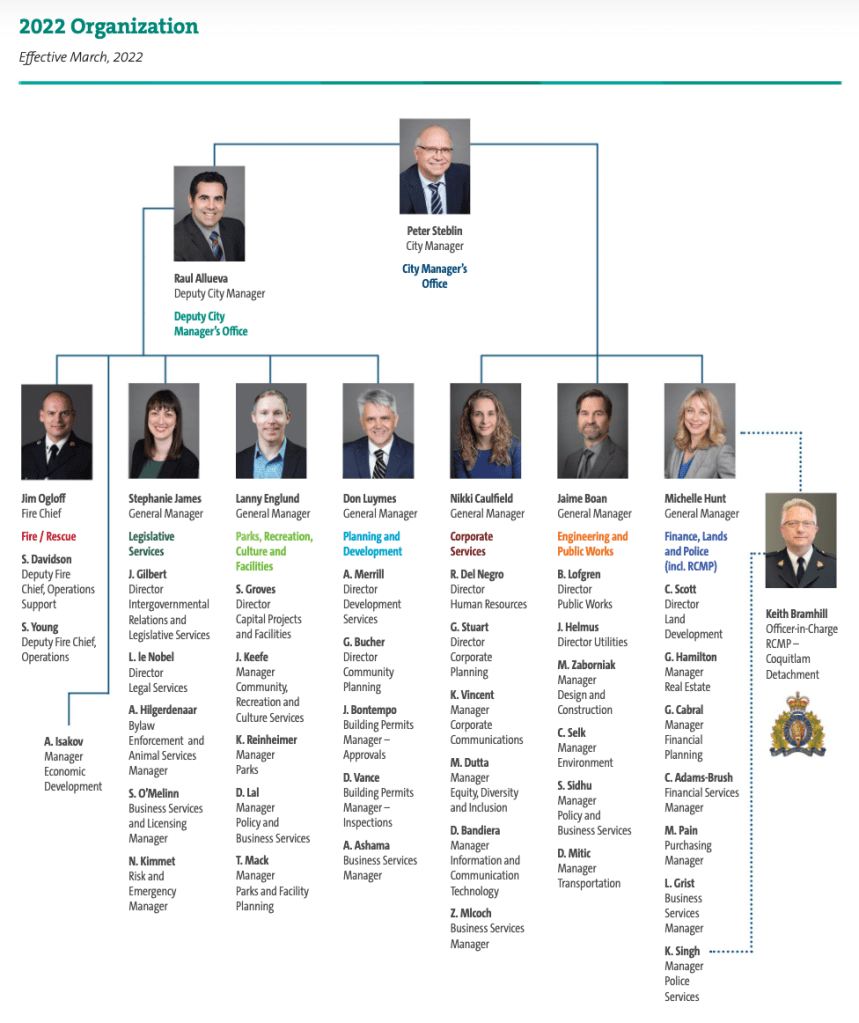
Keith Bramhill, the Officer-in-Charge of Coquitlam’s RCMP, reports to General Manager, Michelle Hunt, who reports to City Manager, Peter Steblin. While the RCMP may report to city staff, city staff report to Mayor & Council. It would seem that Craig Hodge is the city’s elected official who is most involved in police oversight.
Craig Hodge is Chair of Coquitlam’s Community Safety Advisory Committee, member of Coquitlam/Port Coquitlam joint Police Detachment Advisory Committee, Chair of Union of B.C. Community Safety Committee, Co-Chair of Local Government round table on reforming the Police Act, Co-Chair of B.C.’s local Government RCMP Contract Management Committee, and Co-Chair of the Contract Management Committee for the RCMP. Craig also sits on a joint police taskforce, with Mayor Brad West, Councillor Glen Polluck, Mayor Richard Stewart, Councillor Brent Asmundson, and Councillor Steve Darling. Craig states that his role is “to represent municipalities and ensure we’re getting the service we’re paying for.”
Nicola spoke with Craig Hodge, September 7th, 2022. In their conversation, Craig stated that the Coquitlam RCMP are kept “at arms length,” in order “to avoid political interference.” Craig says that municipalities have a large role in policing, but aside from dictating how many officers they wish to have, and for what, the RCMP answers to the federal government, and they dictate how much Coquitlam residents must pay in taxes, for their services.
Between this conversation, Craig Hodge’s website, and an interview he did with Tri-Cities Community TV, below is a summary of his stances on policing:
- Unionization has a cost impact on cities (24% increase in policing costs), and a big bill for 5 years of retroactive pay to the RCMP. “We’re very pleased that the RCMP members are getting a raise, it’s a tough job that they do,” but he also wants to “contain costs.”
- Policing represents 40% of overall policing budget, in most cities – “Policing is a very expensive service, but a very important service.”
- “All police officers are under increased pressure recently.” Craig attributes this to “Covid, George Floyd, BLM, and defund the police.” He is disturbed by police being “heckled in public,” and thinks the backlash it’s pent-up frustration from the pandemic
- Coquitlam RCMP are “highly trained, well respected, I think everybody in the community respects the job that they do.” “People want to see the police more visible, because that gives a sense of safety and security.”
- He is looking for other ways to address mental health calls. “Is it appropriate to have the RCMP, or any police force, responding to mental health calls?” (this amounts to defunding the police, in some people’s minds). He suggests having a mental health unit that 911 can dispatch calls to, directly.
- The opportunity for civilians to go out with police was discontinued about 1 year ago. Craig wants to see the auxiliary program (discontinued by Ottawa due to safety concerns), re-instituted province-wide.
- Police are under increased strain because “provincially we’ve had issues at border crossings, we’ve had things province wide where we’ve had to have police deployments, supporting wildfires, supporting atmospheric rivers.”
- Craig says that we “need to take better care of officers, since they’re human.”
- With regard to Police Act reform, Craig says “this as an opportunity to transition from federal to provincial policing, and that requires investigation into pro’s and con’s.”
- When asked “what benefits are there to having the RCMP, as opposed to a city-led police force, he points to the RCMP being “part of larger organization,” allowing them to “draw on resources across Canada.” “Training and infrastructure are all provide for the city, by the RCMP,” highlighting “economies of scale, integrated teams, and the ability to share between cities.”
- Craig says that it’s important not to have political interference in our police departments, which is why “police board is important.”
- He believes “the implementation of body worn cameras is good.”
“I think that what’s really important is that I think our citizens are very well served by the RCMP. We have no interest in transitioning to another model, but what we do want to make sure is that we’re able to maintain a full compliment of RCMP officers. I think the RCMP does a fantastic job, and I’m very appreciative of the men and women who serve our community, and we just need to make sure that we support them, and when you see the officers out on the street, thank them for the work that they’re doing, because they’re working under some really tough circumstances right now, and I think we need to be appreciative of the work that they do.”
With regard to Nicola’s problems dealing with the RCMP, in terms of being blocked on Twitter, as well as an unwillingness to communicate with Tri-Cities Pride, when she was the President, and negative experiences calling on behalf of those struggling with mental health issues, Craig Hodge says there’s “not much [he] can do.” He also expressed that he is not aware of the issues LGBTQIA2S+ people face, when dealing with police, and is looking to hear about other queer people’s experiences interacting with the Coquitlam RCMP, or police in general.
If you are an LGBTQIA2S+ person, and you would like to speak with Craig Hodge about your experiences dealing with the police, you can contact him at chodge@coquitlam.ca.
– Nicola Spurling –


