

In the lead-up to the 2022 municipal election, some Coquitlam residents were talking about a Tri-City News article that had disappeared, and making wild claims that the mayor of Coquitlam, Richard Stewart, had played some kind of role in the article’s removal.
In response to these allegations, Nicola Spurling filed an FOI request, for all communications between Richard Stewart and representatives of Tri-City News. “I didn’t think I would find much, because if anything shady had occurred, I couldn’t imagine that it would have been recorded in any publicly accessible emails.” Regardless, Nicola thought the FOI request might turn up something interesting, so she moved forward with it.
What Nicola found was not a case of a mayor trying to have articles removed, but rather an instance of a mayor who pushed for an article to be changed, to make him appear more favourable:
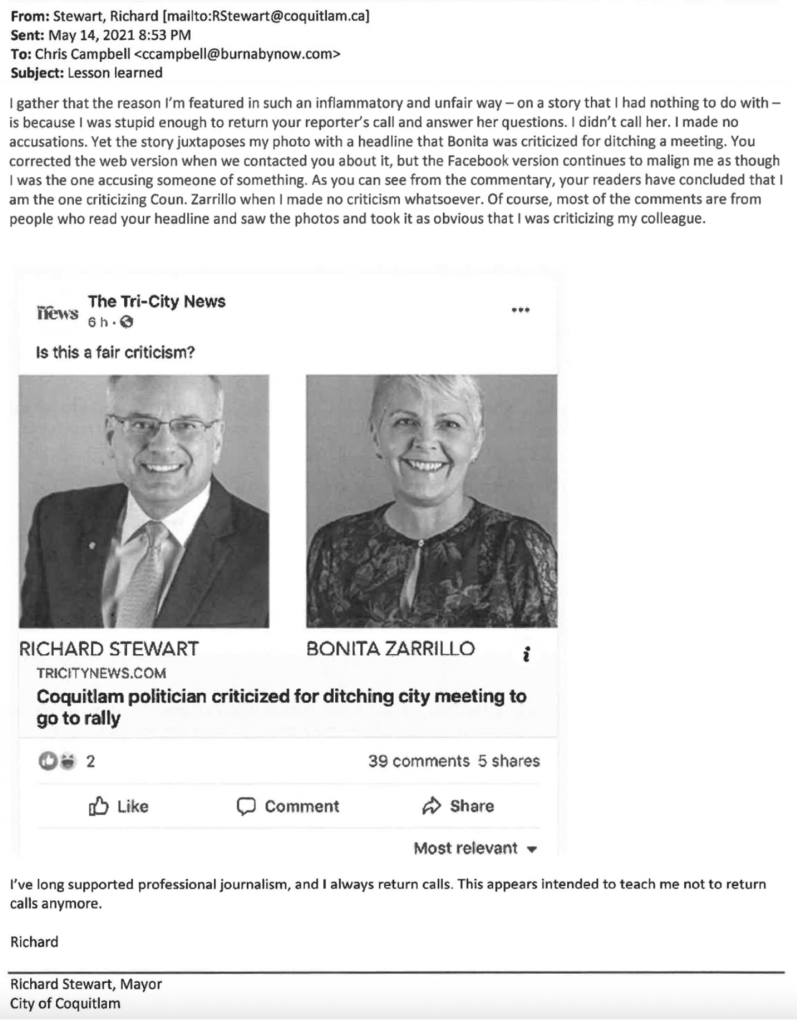
Based on the fact that he did this interview with Tri-City News, and raised these points, it would seem that Richard Stewart cared very deeply about Bonita Zarillo missing a council meeting to attend a rally against anti-Asian hate, despite his claims that he was not “accusing someone of something,” so it makes sense that Tri-City news would have put his picture next to Bonita’s, for their article.
In response to Richard Stewart’s complaint, about members of the public extrapolating that he was being critical of Bonita, Tri-City News updated the article’s picture, to remove Richard Stewart, replacing it with an image of MLA Fin Donnelly, Port Coquitlam Councillor, Nancy McCurrah, and Coquitlam Councillor (now MP), Bonita Zarrillo:
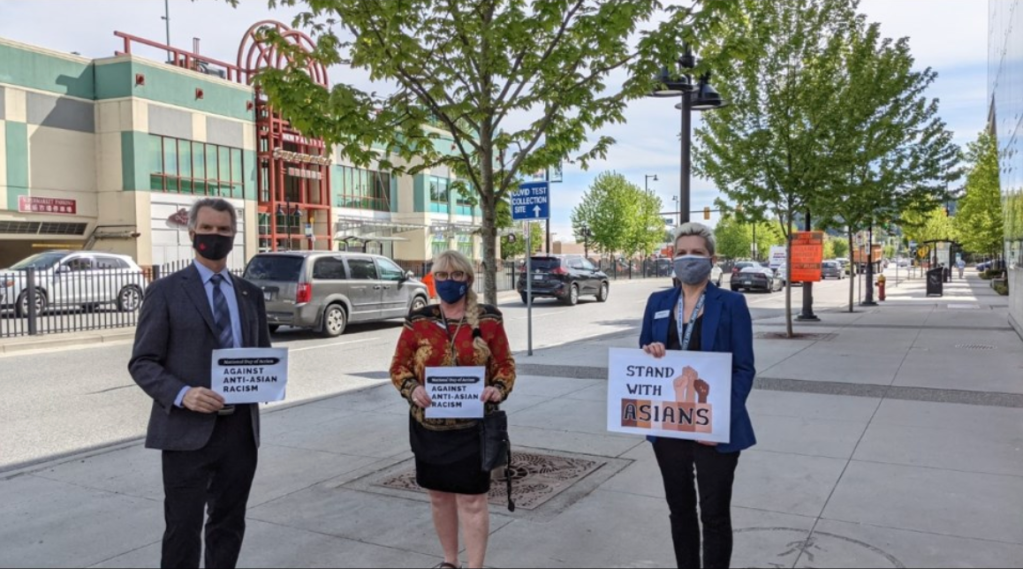
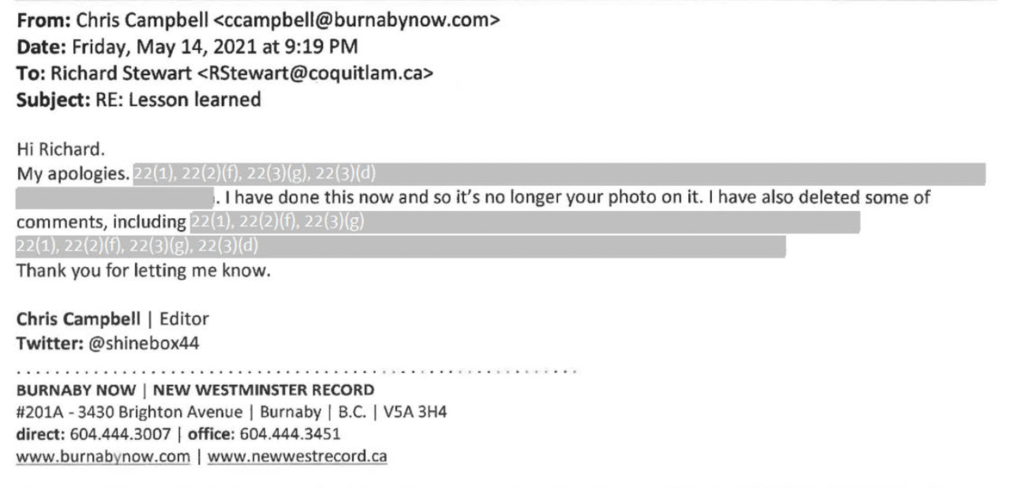
Not only did former Tri-City News reporter, Chris Campbell, change their article’s picture, as a result of the mayor’s pressure, he also deleted comments made by members of the public, on Tri-City News’ Facebook page. These individuals were, seemingly, attempting to engage in their Charter right to Freedom of Expression, without government interference.
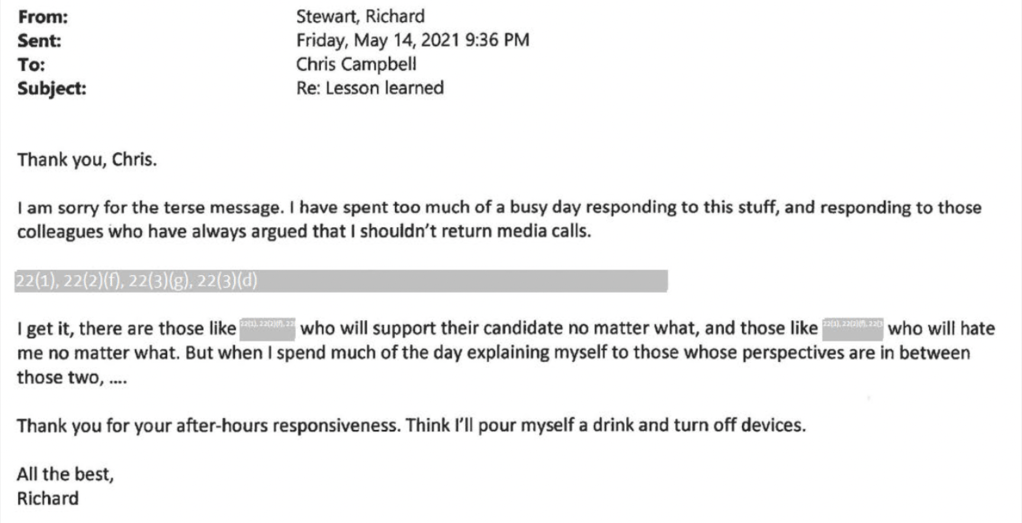
Richard Stewart states that his colleagues argue he “shouldn’t respond to media calls.” This raises concerns around government transparency, which are further compounded by the fact that a significant portions of the emails obtained through this FOI request have been redacted.
Important to remember is that silencing critics is something the mayor of Coquitlam is rather good at, without getting his metaphorical hands too dirty. Near the beginning of the 2022 campaign period, he asked administrators of a local community group for “a better way of handling this,” referring to a member who was critical of him, but who had him blocked on social media, making it “incredibly difficult to correct” them.
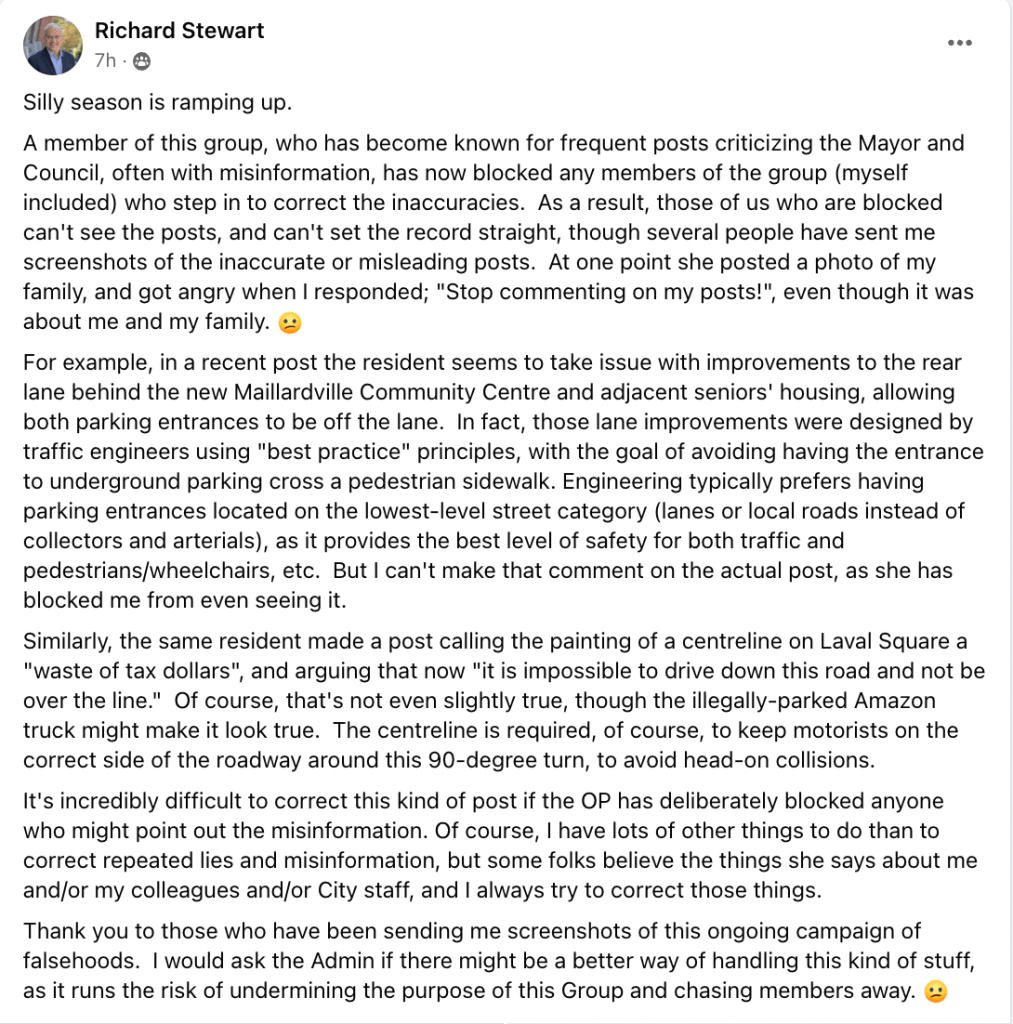
In response to this request, made by the mayor (a very influential person), the administrators removed the resident/constituent in question, thereby removing one of their platforms to criticize the mayor, at the mayor’s request, during the 2022 campaign period. It is always inappropriate for an elected official to attempt to silence their critics, but it’s even more concerning in the lead-up to an election. The idea that a mayor should have the right to force themselves upon someone, in order to defend themselves from criticism, when the person criticizing them wants no contact, is problematic, and raises concerns around consent.
The individual in question may have been ‘bothersome,’ as highlighted by some members of the community group, but everyone has a right to redress their grievances, and it sets a dangerous precedent to create an environment where people can’t have their elected officials blocked on social media and still engage with their community.
Richard Stewart’s attempts to deflect criticism aren’t always in the form of him trying to silence dissension though. Sometimes he responds to criticisms head-on, and other times he attempts to twist people’s criticisms, to make his critics out to be in the wrong, even when they, objectively, aren’t:
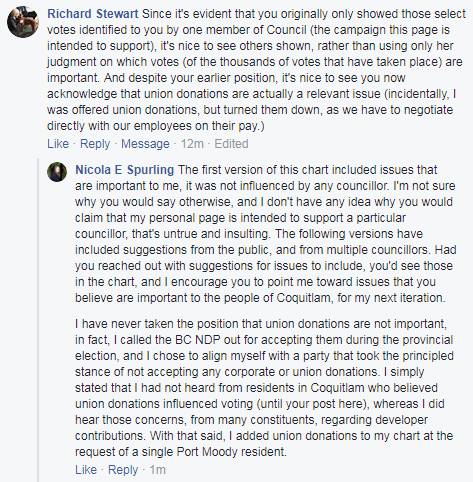
Click here for the exchange, and click here for a deep-dive into developer donations to the 2022 mayoral candidates.
Richard Stewart uses intimidation tactics, in an attempt to scare Coquitlam residents into silence:
Local resident, and childcare advocate, Aimee King says:
“I was only ever pushing for childcare – not slamming policy or anything else… basic, necessary, childcare…I feel like as a citizen (and not another candidate) I am allowed to share opinions without receiving private messages from the mayor…it truly was enough to send me running from politics and all I was advocating for was a daycare plan for Coquitlam.”
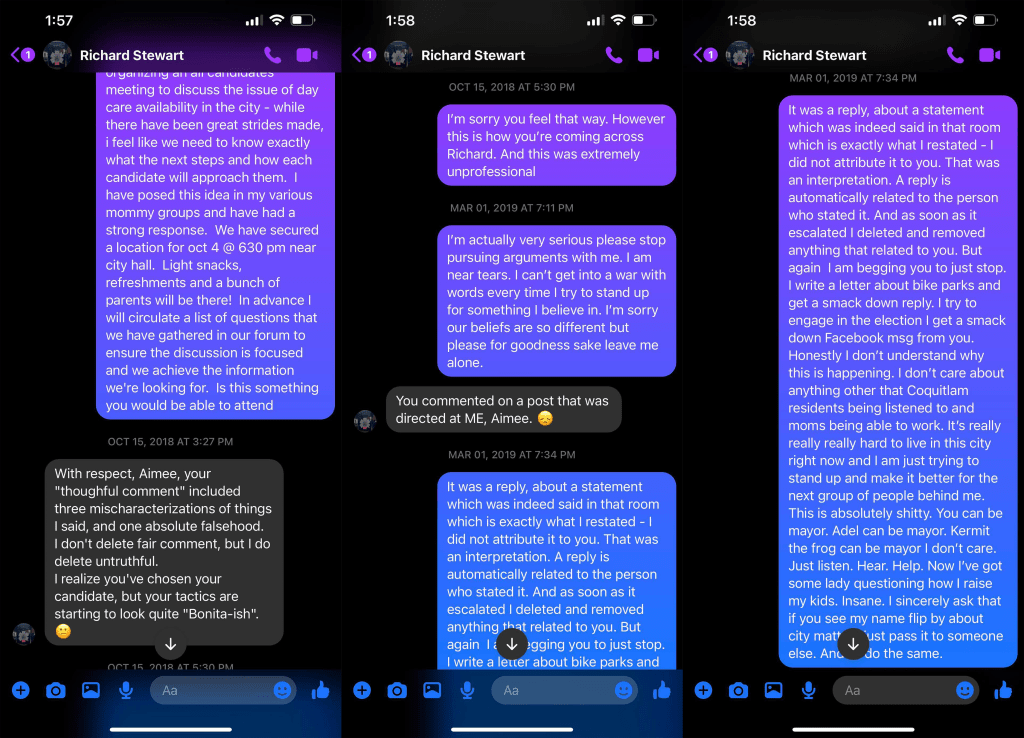
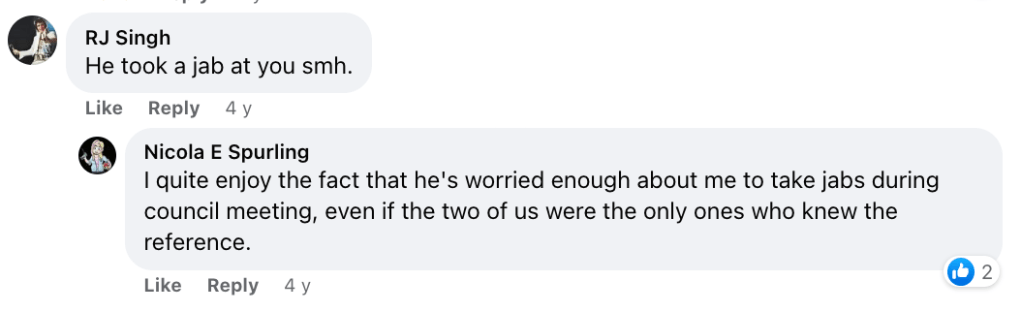
In this exchange, you will note the use of “Bonita-ish,” to describe Aimee’s “tactics,” referring to past Coquitlam Councillor Bonita Zarrillo. Richard Stewart does not appear to like Bonita, and used her name to insult his constituent.
Members of the public should be able redress their grievances without fear of retaliation, and as much as the mayor may not like what some of his constituents have to say about him, they have a well established right to express their thoughts about their elected officials – Freedom of Expression. By contrast, elected officials have no such right to engage with members of the public, should they not wish to engage. If an instance of libel/slander/defamation should occur, that should be dealt with through the proper legal channels, as opposed to through social media.
Nicola reached out to Tri-City News for comment, but did not hear back.
– Nicola Spurling –


