

February 27th, 2023 – Nicola Spurling, a local transgender woman, 2SLGBTQIA+ advocate, political candidate, and journalist, attempted to record at the Coquitlam RCMP detachment, for a news story she’s working on:
I’ve been working on a story about the Coquitlam RCMP for a couple of years, which is currently being delayed as a result of the RCMP not meeting their statutory deadlines for Access to Information requests – a problem that has been plaguing journalists and lawyers. In anticipation of receiving the information necessary to complete my story, I wanted to capture some B-roll footage of the City Hall detachment, to be paired with audio narration for the final release. Upon calling the department, I was told that I was not allowed to record in the building, but that restriction didn’t align with my understanding of the law.
In order to determine my limitations when recording at the Coquitlam RCMP detachment, I consulted multiple lawyers, with a well known criminal defence lawyer doing a great deal of research for me. It was explained that Section 2b of the Canadian Charter of Rights and Freedoms grants us the rights to record in public, and to engage in journalism. I was provided with precedent-setting case law, such as R v Zarafonitis, R v LeBlanc, and R v Jarvis, outlining the instances when a police officer can or can’t stop you from recording. I also received information about the differences between laws on private property, public property, and government-operated facilities.
With this knowledge in mind, I set out to record B-roll footage for my story, prepared to push back on the idea that recording could not occur in the police detachment’s public lobby. I began by phoning the department, but I was quickly shut down, so I went to the detachment in person. By not entering the building while already video recording, or taunting police, as happens in some of the audit videos I’ve come across, and by being as polite and respectful as possible, I was hoping I would be able to explain that the public has a right to record the lobby, and then be left alone to do so.
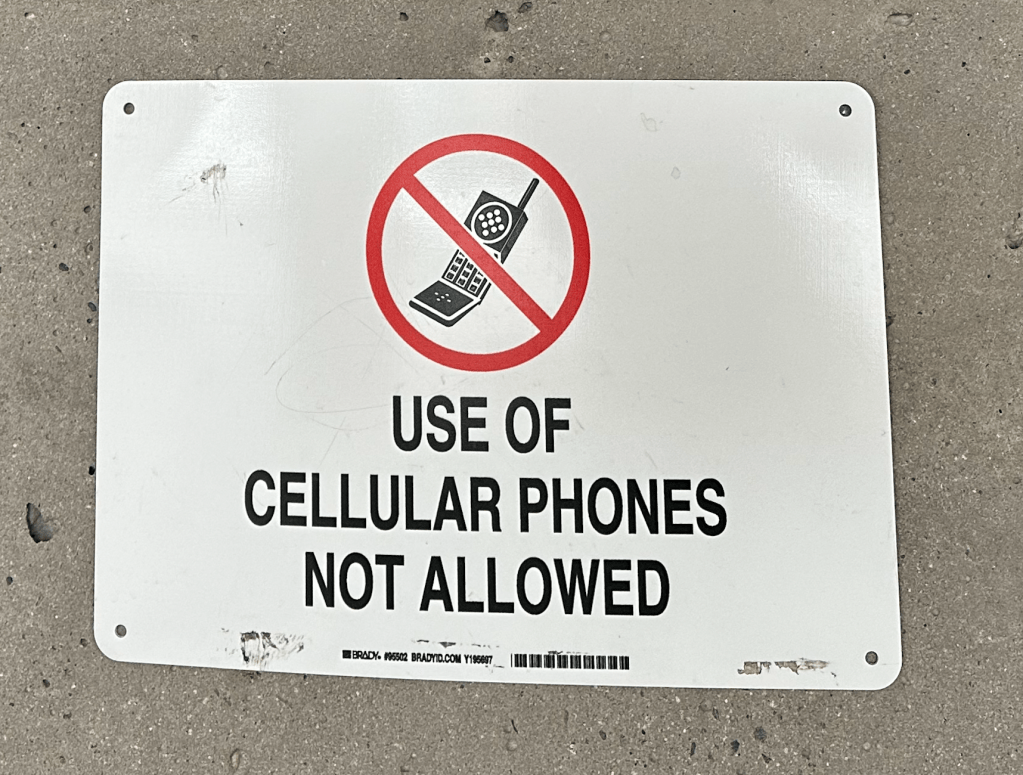
With the conversation repeatedly coming back to ‘you can’t record or we’ll kick you,’ I decided to challenge the “use of cellular phones not allowed” sign. I can’t imagine many people actually abide by that directive while waiting for service, in today’s world.
I peacefully explained that I was going to pull out my cell phone and begin video recording. I invited officers to trespass me, if they believed that to be sufficient reason to revoke my access to the public services I pay taxes for. Upon checking with someone of a higher rank, the RCMP officers, who had previously threatened to remove me from the building, agreed that I would be allowed to stay and record, and left me alone.
Overall, the situation resolved itself peacefully, and I captured the footage I needed, but…
I can’t help but think how much more smoothly things would have gone if the department didn’t have a sign at reception, making people think recording is not allowed. The sign is a major inconvenience to a cell-phone-obsessed population, an unnecessary infringement on the right of journalists to gather information about our government, and opens the Coquitlam RCMP department, and the City of Coquitlam, up to liability, in the event that an officer decides to enforce the sign and violates someone’s rights. It would also have saved us all a lot of time if the Coquitlam RCMP simply understood and respected our rights. The Bylaws department at City Hall subsequently confirmed that no policy preventing recording in government buildings exits in Coquitlam.
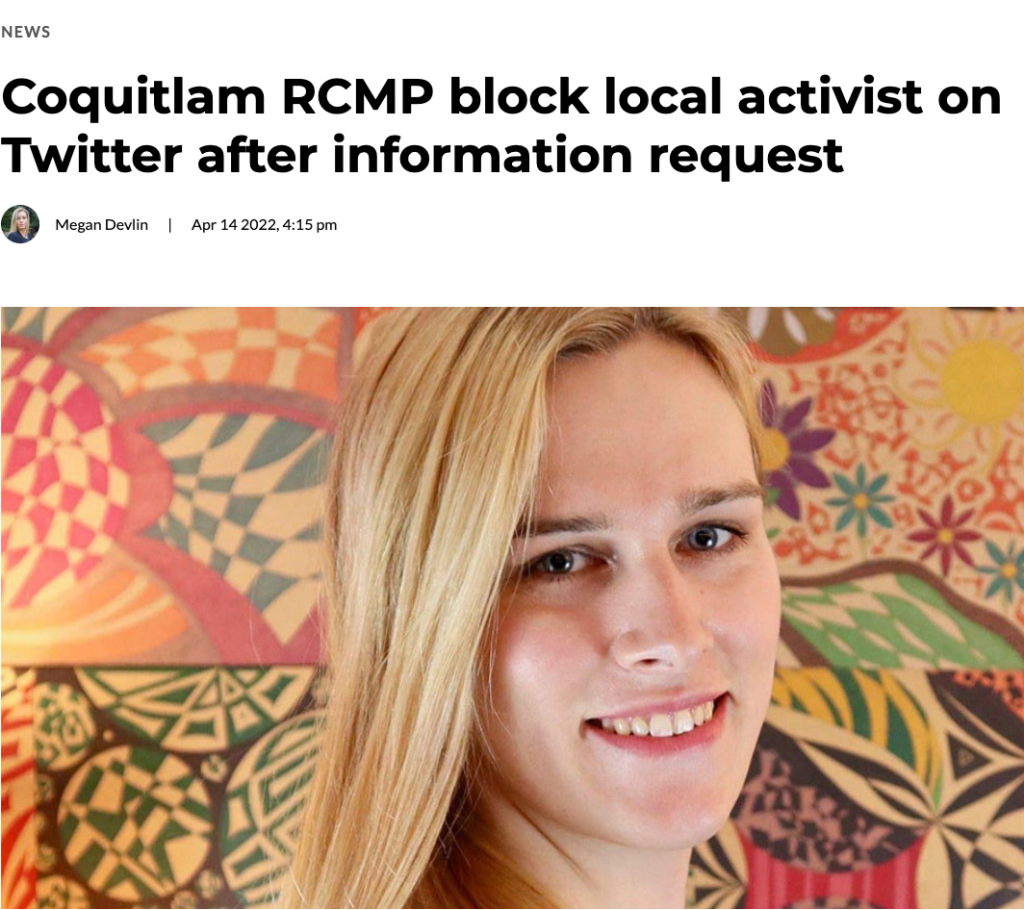
The Coquitlam RCMP have violated my Charter rights previously, in blocking me from viewing their public social media statements, due to my filing of ATIP requests. They lied about me in an interview with Daily Hive, incorrectly claiming I had revealed someone’s personal information, to justify why they blocked me. I also recently discovered that they lied about me in a police report I made a few years ago, when I was being stalked, harassed and threatened, and called for help. My past interactions with members of this department, and this pattern of lying, is why I didn’t immediately trust that the information I was being given by the department, about recording police in public, was accurate. Thankfully, there are good lawyers willing to help.
If you’ve made it this far, and you want to see what transpired, this is the full video:
If this issue is important to you, please contact the Coquitlam RCMP, and the City of Coquitlam, to let them know that their “use of cellular phones not allowed” sign is an infringement on our Charter rights, and that you would like them to take it down.


 nicsnews.ca